


The Handoff Is the Moment of Truth for Healthcare Voice AI
“Can I Get Your Date of Birth?”
A patient calls to move her cardiology appointment. The voice AI answers right away. It verifies her identity with her date of birth and a text message code. It finds her appointment. It offers two new times, but she needs a morning slot after the 28th and none are open. So it transfers her to the scheduling team.
The scheduler picks up and says: “Thank you for calling. Can I get your date of birth?”
In that one sentence, three minutes of good work disappears. The patient verified herself for nothing. She explains her problem again. And the next time she calls, she will press zero the moment the AI answers.
We talk a lot about how much a voice agent can automate, and much less about the calls it cannot finish. In healthcare, those are often the ones that matter most. The handoff is the moment of truth for healthcare voice AI. Get it right, and every human conversation gets shorter. Get it wrong, and the AI makes the experience worse than having no AI at all.
The Handoff Gap
Repeating information is not a minor irritation in healthcare. It changes how patients feel about their care. In its Patient-Reported Indicator Surveys of more than 107,000 primary care patients, the OECD found that patients who had to repeat information that should already have been in their records were about 15 percentage points less likely to rate their care positively or to trust the health system. Among patients with chronic conditions, trust dropped by 30%. Those patients repeated themselves in an exam room. On the phone, the same failure happens every time a call is transferred without context.
Healthcare’s version of this problem is older than voice AI. As Becker’s Hospital Review has described, a central call center collects a patient’s information, then transfers the call to a scheduler who asks the same questions again.
Voice AI was supposed to fix this. Too often, it adds one more step: the AI collects information, and the human collects it again. Patients notice. In a 2026 Gartner survey of more than 3,500 customers, 87% said companies using generative AI for service must provide access to a human agent. Gartner’s guidance goes a step further: when AI cannot resolve an issue, it should pass the information and context it already collected to the human agent. The cost of getting this wrong is steep, because only 27% of customers would try a chatbot again after a negative experience. That is the patient in our opening story, who will press zero the next time the AI answers.
For patients who depend on the phone, the contact center is the front door to care. When they give up, they do not switch brands. They miss an appointment.
Why a Screen Pop Is Not Enough
Contact centers have passed data to agents for decades, but a classic screen pop shows little more than the phone number and the menu option pressed. “Pressed 2 for scheduling” is data, not context. An AI agent is different. It has heard the whole conversation and knows what the caller asked for, what it looked up and where it got stuck. The question is whether that understanding reaches the person who picks up.
What AI-Generated Call Context Carries
A good handoff turns a transfer into a briefing. When the call lands, the human agent sees five things before saying hello:
- Who is calling and whether they are verified. The briefing shows the caller’s name, record number, primary clinic and how identity was confirmed. If verification is complete, the agent does not repeat it.
- Why they are calling. The briefing states the caller’s intent in plain language, not as a menu code. “Wants the first morning cardiology slot after October 28” is something an agent can act on.
- What the AI already did. The briefing lists every step the AI completed, such as finding the appointment, offering two slots and opening a ticket. The agent picks up where the AI stopped, not where the call started.
- Why it handed off. Common reasons include no available slots, an account flag that only a specialist can clear, or a request outside policy. The reason tells the agent what kind of problem they are walking into.
- What to do next. The briefing suggests the fastest path to resolution, for example, “add to waitlist, offer a callback, patient prefers text.” The agent can accept it, change it, or ignore it.
When the agent finishes, one more thing happens: the agent records the outcome as resolved, escalated or callback scheduled. That outcome flows back to the AI and becomes a signal for how the next similar call should be handled.
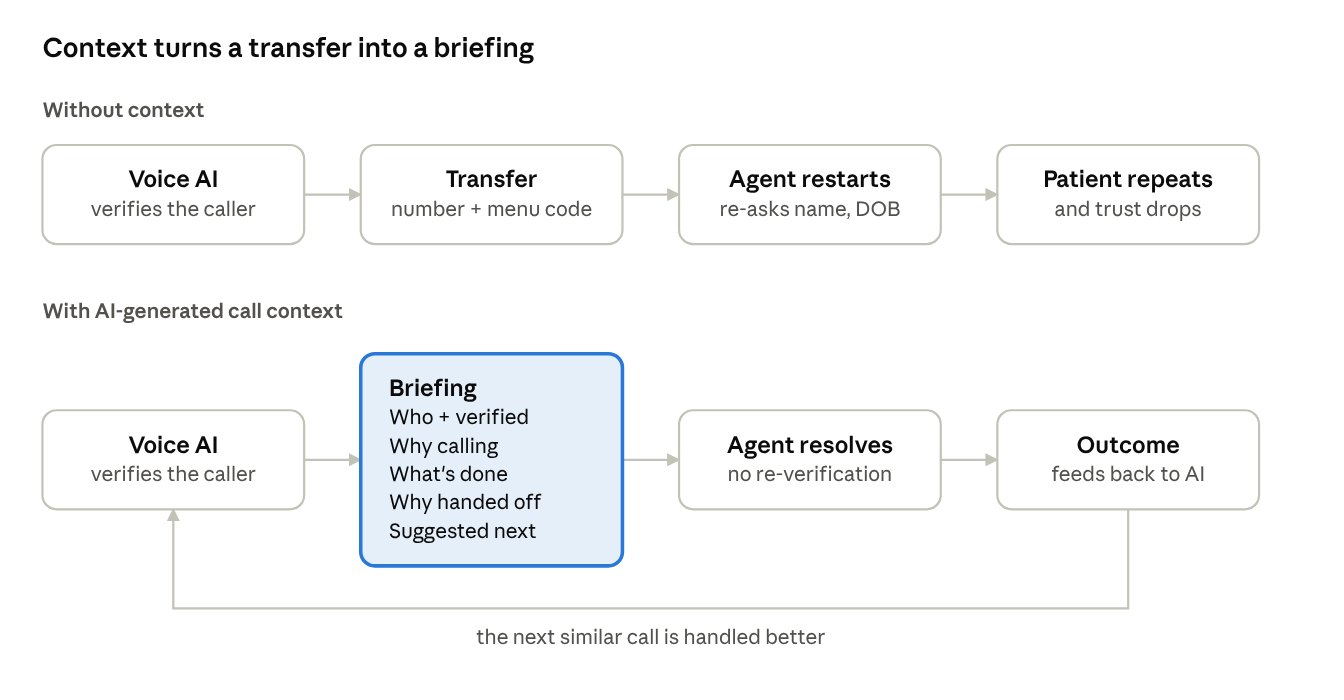
Without context, the AI’s work stops at the transfer. With context, the human agent starts from the briefing, and the outcome teaches the AI.
How We Approach the Handoff at Parlance
At Parlance, we treat the handoff as part of the product, not the place where the product ends. These are the design rules we hold ourselves to:
- Context travels with the call. When our voice agent transfers a call, the full briefing appears on the agent desktop the moment the agent accepts. The agent does not need to copy and paste or run a separate lookup.
- Useful even when the AI never touched the call. A caller who dials a department directly still gets an identity panel, looked up by phone number against the EHR, the identity provider and prior call history. Agents get value from day one, before a voice agent is ever deployed.
- Verified and interpreted are not the same. A verified identity or an appointment read from the EHR is a fact. An intent or a suggested next step is the AI’s interpretation. We show them differently, so the agent knows what to trust and what to confirm.
- Ready before hello. The briefing is built continuously during the conversation, not generated at the moment of transfer. By the time the agent’s phone rings, the briefing is already there.
- Access is controlled and logged. Each health system decides what its agents see, with a summary as the default, and fields an agent is not permitted to see never leave the Parlance service. Every view of a caller’s context is logged and handled as protected health information under a business associate agreement.
- The outcome closes the loop. The agent’s wrap-up result feeds back to the voice agent. Calls that keep ending the same way tell us where the AI should do more, or hand off sooner.
The principle underneath all six is the one from my post on the intelligent context layer: right context beats more context. The agent needs a briefing, not a chart.
What It Solves for Health Systems
Replay the cardiology call with context in place. This time, the scheduler picks up and says: “Hi, I see you’re looking for a morning cardiology slot after the 28th. Nothing is open yet, so let me add you to the waitlist and text you when one opens. Does that work?” The call takes ninety seconds. She never repeats her date of birth.
At contact center volume, a better handoff pays off in five ways:
- Patients stop repeating themselves and learn the AI is worth talking to next time.
- Agents start every call informed. They do not re-verify callers or guess why the call came to them.
- Handle time and callbacks go down. A call resolved the first time does not come back tomorrow.
- Patients most at risk are not lost at the handoff. Those who rely on the phone stay in care instead of in a queue.
- Compliance teams get control and an audit trail. Each health system sets what agents can see, and every access is logged.
Judge Voice AI by Its Handoffs
Most voice AI demos end when the agent completes a task. The better test is what happens when the agent cannot. A voice agent that resolves 60% of calls and hands the other 40% to agents with nothing has improved the 60% and made the 40% worse.
When you evaluate voice AI, ask the vendor to show you a transfer. What does the agent see when the phone rings? Is the caller already verified? Does the agent know what was tried and why it stopped? Does the agent’s outcome make the AI better?
If the answer is a phone number and a menu code, the AI is answering calls, not helping patients. If you want to talk through what a good handoff looks like in your contact center, reach out to our team.
Sanjay Yadav is Head of Engineering at Parlance, where he leads the team building the company’s conversational AI platform for healthcare. His work spans real-time voice AI, speech recognition, and integrations with the EHR and contact center systems health systems run on, including Epic, Oracle Health, Meditech, athenahealth, Webex Contact Center and Five9. Since joining Parlance in 2022, he has led the move of the Parlance platform to a microservices architecture and the company’s shift to AI-native product development. Sanjay brings more than 20 years of engineering leadership across healthcare, education, fintech and application security, including founding the engineering team behind a clinical trial SaaS platform at ERT. He speaks regularly on AI architecture and workflow redesign, most recently at Volaris Quadrants and MassTLC.