
Meet Parlance at Upcoming Healthcare Events. Details

Main Menu
  • Home
  • Solutions

      Solutions

      Switchboard
      Contact Center
      Clinics
      Speech Attendant
      Call Routing
      Log in
      Request a Demo

      Featured Solution

      Unlocking the Key to Health Equity in the Revenue Cycle

      In Revenue Cycle, people and technology are our greatest assets to eliminate health disparity and achieve health equity.

  • Industries
      Healthcare
      Enterprise
      Higher Education
      Log in
      Request a Demo

      Featured Customer Story

      Hendrick Health Improves Patient Experience

      Duane Donaway, Director of Technology at Hendrick Health, discusses the benefits of Parlance.

  • Resources
      Blog
      Media
      Publications
      Glossary
      Log in
      Request a Demo

      Featured Blog

      Put a Kaizen Lens on the Process of Answering the Phone in a Large Health System

      Learn how to reduce wasted labor and patient frustration as you transform your health system's voice channel.

  • About Us
      About Us
      Our Team
      Customer Stories
      Open Jobs
      Contact Us
      Log in
      Request a Demo

      Featured Team Member

      Linton Featured Team Member - Parlance

      Linton Ranson, IT System Administrator

      At Parlance, we execute monthly employee security training programs and real-world phishing simulation campaigns that reduce our vulnerability to threats and ensure operational integrity. Parlance is fiercely committed to safeguarding sensitive patient information and maintaining regulatory compliance standards.

Log In
Request a Demo
Main Menu
  • Home
  • Solutions

      Solutions

      Switchboard
      Contact Center
      Clinics
      Speech Attendant
      Call Routing
      Log in
      Request a Demo

      Featured Solution

      Unlocking the Key to Health Equity in the Revenue Cycle

      In Revenue Cycle, people and technology are our greatest assets to eliminate health disparity and achieve health equity.

  • Industries
      Healthcare
      Enterprise
      Higher Education
      Log in
      Request a Demo

      Featured Customer Story

      Hendrick Health Improves Patient Experience

      Duane Donaway, Director of Technology at Hendrick Health, discusses the benefits of Parlance.

  • Resources
      Blog
      Media
      Publications
      Glossary
      Log in
      Request a Demo

      Featured Blog

      Put a Kaizen Lens on the Process of Answering the Phone in a Large Health System

      Learn how to reduce wasted labor and patient frustration as you transform your health system's voice channel.

  • About Us
      About Us
      Our Team
      Customer Stories
      Open Jobs
      Contact Us
      Log in
      Request a Demo

      Featured Team Member

      Linton Featured Team Member - Parlance

      Linton Ranson, IT System Administrator

      At Parlance, we execute monthly employee security training programs and real-world phishing simulation campaigns that reduce our vulnerability to threats and ensure operational integrity. Parlance is fiercely committed to safeguarding sensitive patient information and maintaining regulatory compliance standards.

Category Tags

  • agent experience
  • business optimization
  • call routing
  • IVA
  • IVR
  • managed service
  • patient experience
  • security
  • speech attendant
  • switchboard
  • technology
  • Videos
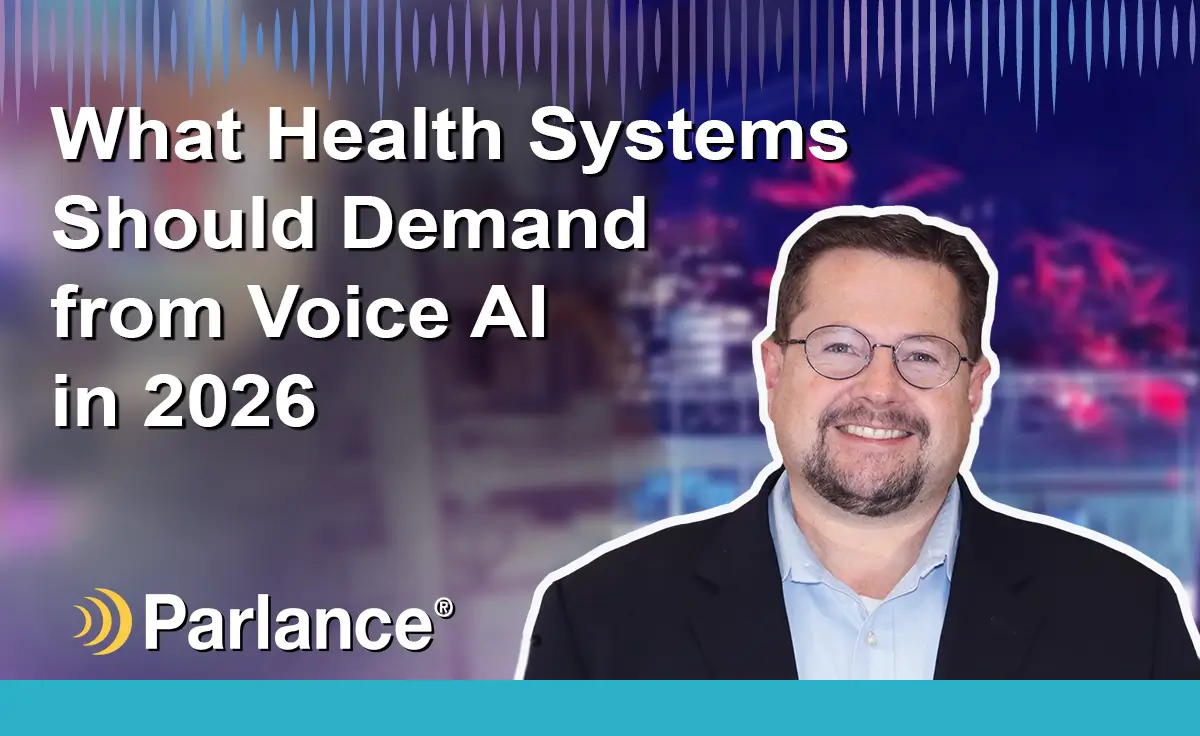
GRAPHIC_BLOG_Scott_What Health Systems Should Demand from Voice AI in 2026
Picture of Scott D’Entremont
  • Picture of Scott D’Entremont Scott D’Entremont
18 min

Published on

  • 03 Jun 2026
Share via

Blog Summary

The hype cycle around agentic AI in healthcare is finally cooling and the gap between a polished demo and a production-grade voice AI deployment has never been wider. For health system leaders, 2026 isn’t the year to be impressed by a sandbox. It’s the year to demand proof. Phone access remains one of the top patient-access priorities, 80%+ of appointments are still booked by phone, and missed inbound calls are the leading cause of $150 billion in lost appointment revenue annually. Most “agentic” voice AI being marketed today is a thin orchestration layer with no operational footprint inside a health system and it breaks the moment it meets real-world conditions: regional accents, EHR slowdowns, and thousands of calls in queue at 4:47 PM on a Friday. This post lays out the five questions every health system leader should put on the table before signing a voice AI contract in 2026, and what separates operators who own the outcome from vendors who own the demo.

Healthcare Voice AI: 5 Questions to Ask in 2026

Walk the HIMSS 2026 exhibit floor and one phrase came back from every booth: agentic AI. The trade press picked up the cadence within a week — Becker’s, HealthcareITNews, Wolters Kluwer, Chief Healthcare Executive and converged on a single recap line: 2026 is the year voice AI moves from pilot to production. That framing is correct. It is also dangerously incomplete.


The hype cycle around voice AI in healthcare is finally cooling. Real questions are surfacing. And the gap between a polished demo and a production-grade contact center is the widest it has ever been.


On a recent customer visit, the conversation centered around one of the health system’s very real challenges, patients could not get appointments to see their physicians. Staff was dealing with people walking into clinics because they were waiting on hold for so long, to talk to a person.


The Frame Has Shifted — Quietly
Becker’s Hospital Review reports that 36% of healthcare executives are already using agentic AI to support workflows. MGMA’s December 2025 stat poll places phone access in the top three patient-access priorities for 2026 at 22% of medical groups. One of the largest integrated health systems in the country, the Veterans Health Administration, estimates the cost of missed appointments to be $564 million annually, and missed inbound calls remain the leading root cause.


Here’s the reality. The “36% of healthcare executives already using agentic AI” may describe what’s being purchased, but it likely doesn’t describe what’s actually in production.


A demo runs in a sandbox. But the real test comes at 4:47 on a Friday afternoon, with thousands of calls in queue, an EHR slowdown in the background, and a parent on the line trying to reschedule a pediatric MRI. This is the test that most “agentic” voice AI never sees.

Where “Agentic” Breaks Under Load
When voice AI fails in production, it fails in three predictable places. It fails on the long tail of accents and background noise that never appear in a vendor’s training data. It fails on the integrations, the moments when the conversation should hand off cleanly to scheduling, registration, or finance, but instead drops into a black hole. And it fails on the hand-back to a human agent, because the live agent inherits no context, no transcript, and no patient state.


The operational backdrop is unforgiving. The volume of inbound calls to a typical health system contact center continues to climb while staffing remains the same, and a meaningful share of those calls are missed entirely. A study published in the American Journal of Managed Care found that longer phone hold times directly correlate with patients feeling they cannot access timely care — and patients who experience repeated poor phone interactions are four times more likely to switch providers. The average hold time at healthcare call centers is 4.4 minutes, more than five times the 50-second standard recommended by the Healthcare Financial Management Association. 


Roughly 80% of appointments are still booked over the phone. Despite years of investment in patient portals and digital tools, a 2024 MGMA poll found that only 11% of medical groups have most of their patients scheduling appointments digitally — meaning the phone remains the dominant channel for the majority of health systems. Every minute the voice channel is compromised, you are losing patients to more responsive providers.


The Infrastructure Problem Nobody Puts on a Slide
Let me be direct. Most “agentic” voice AI being marketed in healthcare today is a thin orchestration layer sitting on a generic large language model, bolted onto a generic ASR engine, sold by a vendor with no operational footprint inside a health system.


That model breaks the moment it meets a real environment. Health systems run on fragmented phone systems, hybrid PBX deployments, on-premise SIP trunks, regional accents, and clinical edge cases that do not exist in consumer datasets. Deploy-and-depart is not a deployment. It is a press release.


What works is a managed service operated by people who have been inside healthcare contact centers for three decades. Parlance is a team that owns the result, not the demo. A team that names the metrics — containment rate, first-call resolution, agent hours saved, abandonment rate — before the contract is signed and reports against them afterward.


The Five Questions I’d Put on the Table
The most important shift in 2026 is not technological. It is operational. Health systems are no longer asking whether voice AI works in a demo. They are asking whether a vendor can stand inside a contact center on a Tuesday morning and own the outcome. That is a different question.


Here are the five questions I would put on the table before signing a voice AI contract this year:


1. Show me a deployment that has been in production for at least 24 months at a comparable health system, with a named reference I can call.
2. Define containment, abandonment, and first-call resolution as you measure them, then show me last month’s report, not a sales slide deck.
3. Walk me through how the platform handles accents, complicated provider names, and prescription names, without a custom training cycle for every deployment.
4. Describe what happens when the call is handed to a human agent. What context, transcript, and patient state arrive with the call.
5. Tell me which vendor team members will still be working alongside the contact center team the week after go-live, the month after, and the year after. Then ask how the vendor’s business model is structured so that their success is only possible if yours is.


After 30 years of building voice technology for the healthcare industry, the team at Parlance has answered every one of those questions in production. The market is finally ready to ask them.

By Scott D’Entremont

Scott D’Entremont is CEO of Parlance Corporation, which provides conversational AI solutions for healthcare systems across the United States. Prior to becoming CEO, Scott served as Chief Revenue Officer and has specialized in healthcare IT for 10 years.

LINKS

  • https://www.mckinsey.com/capabilities/operations/our-insights/where-is-customer-care-in-2024
  • https://www.forbes.com/sites/janicegassam/2019/11/11/dear-businesses-generation-z-does-not-want-to-hear-please-hold/
  • https://www.forbes.com/councils/forbestechcouncil/2025/02/13/hang-up-your-age-old-stereotypes-gen-z-is-on-the-phone-for-customer-service-needs/


TRANSCRIPT:

This episode is brought to you by Parlance. Elevate patient and staff experiences with AI voice driven solutions from Parlance. Automate call handling, streamline switchboards and contact centers, and enable quick, accurate call routing in hospitals and clinics.


Improve patient experience and reduce the workload on your staff. With smart communication solutions from Parlance. Visit ThisWeekHealth. com slash ParlanceCorp today to transform your healthcare interactions.


I’m Bill Russell, creator of this Week Health, where our mission is to transform healthcare, one connection at a time. This is an executive interview


quick powerful Conversations with Leaders Driving Change. So let’s get started.


Today we have an executive interview and I’m excited to be joined by Scott Don Remont, CEO of Parlance corporation. And Scott, welcome back to the show. It’s been a, it’s been a while. It has. Time goes


I was in a CTO meeting last week and we started talking a lot of talk about how to deal with the financial pressures that exists within healthcare. And one of the, one of the people actually brought up parlance and what they’re doing and call center and trying to get in front of things and, Uh, it was specifically in that context of reducing costs. And I thought that was interesting. I’ve heard it in terms of, improving the experience, but it was really both both. And for this CTO.


Yeah. Yeah, that’s interesting. That doesn’t happen often enough that our name comes up in those rooms, so I appreciate that.


I’ll ask you after the interview, maybe I’ll put you on the spot for who that was, but you know, cost. Cost is huge. It represents 30 to 50% of what gets spent in healthcare. Everyone would like to see more spent on. Clinical spending rather than kind of the cost of administering the system. Of course as pressure is increased financially.


That phenomenon has just become more and more important. So we think we have a really straightforward way to help people reduce costs. It’s kind of common sense. It enhances what people Are able to do and lets agents in call centers and at the front desks of clinics and operator groups focus on the places where they really need personal, personalized help and guidance.


And for the routine tasks. Software can go ahead and. Handle those things. I think two other things are becoming more clear as interesting to CTOs and those are just how much leakage there is in referrals and where this kind of technology can help out. I was kind of searching around and depending on what you’re reading, it’s somewhere between 30 and 50% of referrals escape the healthcare system.


And as there’s so much pressure on, reducing, expenses, bringing in more revenue certainly is something that people are more and more interested in as well. And, you can’t forget about patient experience. I think it’s critically important Yeah. To keep our eye on the ball there as we try to manage the businesses.


So help me understand how your solution how does it address leakage and how does it address those referrals going outside?


To automate that process and follow up and call back is one of the ways. The other way is to sort of, share the data across the system and know who might be calling back.


Even things that are as simple as cancellations. We’ll find with our customers that somebody will send a notice out, at four o’clock, close the office. And those calls may well roll to the main hospital system where, an agent will greet the person and say, Hey, thanks for calling.,


How can I help you? And the caller will say, I don’t know, you guys called me. So we’re, we’re able to be able to know who that’s calling and why they’re probably calling back and make that a much better experience.


So Scott, I have a standard colonoscopy coming up and so I have the.


Primary care physician referring, I have the doctor who’s gonna be performing the procedure, and I’m dealing with that office, and I’m dealing with the hospital as well. I can honestly tell you that I think between those three entities this week, I have fielded, I don’t know, eight phone calls, which is great.


Yeah, I mean, they’re very responsive. They’re reaching out, they’re making sure I’m ready. I know where to go, all this other stuff. Right. That’s a lot of phone. I it’s, it’s, it’s like it, they’re over-communicating and it’s almost becoming my wife was like, are like, she heard me talking and she’s like, again, you’re talking to them again.


Yeah. I think it’s hard to get it right. I have the exact same thing going on, except what happened is I got one phone call, I missed it, and then I jotted a time like, oh, Scott, you really have to make this appointment when things calm down in November. But that’s it. I haven’t gotten any other fallback.


It was a live human who’s probably very busy and my name is probably on some list somewhere. And, maybe in another six weeks they’d call me back. But they really don’t have to. Can you imagine if I was able to just hit two and schedule it or pick up the call and get it done right then, and that didn’t need to be a person necessarily.


These are it’s a group I’ve used for a long time. I really wouldn’t need to speak with a person.


Well, it was interesting in the CTO meeting for it to come up in the context of cost savings because that led to a conversation around the call center and it’s like, man, that call center is, first of all, we have a lot of them, we have a lot of, physician practices.


practices.


the CTOs are sort of looking at us going, this is harder than it looks. I’m like, what? Alright, help me understand why it’s so hard. And they’re like, well. Our phone systems aren’t necessarily all linked together yet. We’re a lot better than we were last year, and we’re a ton better than we were three years ago.


But still we have some technical challenges there. Then we’re still dealing with multiple call centers. We’re dealing with integration issues into the EHR itself. I mean, so they were sort of painting a picture of Yes we, we know there’s, it’s like we know there’s gold in, then there hills.


Yeah, but it’s some work to get it.


Yeah. That, That’s part of our experience with our customers too. I’d add on to that, that what we see is even probably a bigger challenge is just standardized workflows. Yep. At the end of the day, if somebody’s sort of tagged as an orthopedist, but they only do left knees on Tuesdays.


Another guy only does hands, they both look like orthopedists. It’s extremely difficult for automation to sort of figure that out. We’ve made great strides forward with AI to be able to be a little smarter about slot selection, but at the end of the day, it’s really about helping guide our customers to those processes, which is why a couple of years ago we went out and hired, not people that are call center experts initially, but people that are expert at kind of consulting with our customers to figure out how do we approach, the practice and how do we kind of, how do we kind of get there? Everything’s always phased for us so that we can kind of deliver value.


The technology’s always ahead of what the system is ready to do, so we try to tee up the next thing. But I would tell you that the number. One easily solved problem in contact centers that we see are calls that don’t belong. So when there’s a lot of call centers, what that means is a lot of call centers get calls they can’t help with, so we’ll find a better, a call center for instance, is doing all kinds of primary care appointments, but they don’t do any of the radiology appointments, but somebody has that phone number, so they’re calling for a mammogram, and they’re waiting through the whole queue only to get to an agent.


That says, geez. We don’t do that here. Hold on, let me transfer to somebody else that may well have a queue. So we’ve continued, it’s kind of in our DNA to be really good at navigating calls around a healthcare system. We think it’s more important than ever. So for our customers, if you call and you ask for a mammogram, you don’t know that you called the wrong number.


We hear mammogram. We send you to the right place in the system for the mammogram. It’s a very practical way to get an immediate savings. It’s the easiest, honestly, part of what we do. It delivers immediate value for our customers there. If you think of Kaizen, Kaizen, sorry, and just waste, there’s nothing more wasteful for the patient or the call center to field calls that you can’t help with at all and need to transfer them as a human operator.


I wanna talk to you about another phenomena. I, I’m, I’m on record just saying two guys in a garage are gonna come out with ambient listening tomorrow because it almost was that kind of thing was going on where people were like, oh my gosh, look what I can do with this large language model.


And I put this in front of it and all of a sudden I have agents and boom. And you have two, two people from a garage coming out there and saying. And we’re in healthcare, it’s like, oh, slow down, slow down there. but it feels like the same thing’s happening in your space. It’s like everybody and their brothers sort of coming outta the blue saying, oh look what we could do with this LLM.


And you’re like whoa. Wait a minute. This is, yeah, for sure. This is healthcare.


Yeah, for sure. I mean, and very bluntly, a lot of those guys go, oh, in a company like parlance that’s been successful for 25 years, that’s a legacy provider. So you wanna do us new shiny stuff even though, we’ve got two customers and 14 salespeople and some money in the bank for the moment that we’re spending down and we’re gonna figure out healthcare ’cause it’s a great application.


According to our VCs, we’re seeing more of that than ever. We’ll be out at Becker’s next week, and there’s some sort of new competitors there. So it’s sort of interesting, we’ve taken a very different approach. The company has been in business for about 28 years.


Last year the company was acquired by Constellation Software. They’re a publicly traded conglomerate that sort of models themselves after Warren Buffet where they acquire a company. The companies remain independent. They’re part of the overall team and have access to those resources, but they continue to operate individually.


These guys have never sold a business, so we feel really lucky to be in that position where we’re not worried about payroll, where we’ve got. Lots of long-term relationships, really smart people both on the healthcare side, people that ran healthcare contact centers, people that were in healthcare it for decades, as well as really sharp developers.


So we think we’re in a really great position, but I’ll tell you, bill, I don’t think it’s been in my seven years in the business any noisier than it is today with sort of new people and more shiny stuff for kind of a confused market to look at.


I mean, I, I want to emphasize the specific industry knowledge is so important in, in a, an application like this, in, in bringing it to fruition.


’cause it’s all about adoption. It’s all about usage. It’s all about creating the experience. It’s all about integration and all of those things require special knowledge within healthcare. But but I don’t want to, I don’t wanna downplay. Some of the really cool things we’re seeing in terms of advances and those kind of things, how are you guys keeping up and what are some of the things some of the newer things that you guys are incorporating?


So, we’re doing kind of two different things. Like everyone, we’re kind of making sure we’re in a position to take advantage of kind of the latest and greatest models that are out there. We’re doing a lot more with small language models now. I think like everyone, Nvidia chips are in there.


That’s probably the one thing that we’re kind of all are looking around and going, holy cow, can this what, what can’t these things do? But at the same time we’re doubling down on. Really using these kinds of technologies to enhance what we’ve been good at for a long time, which is navigation. So we’ve developed some proprietary software that kind of, it’s a vector embedding search model that allows us to match proper names and locations better we think than anyone else.


It’s not something that other people pay a lot of attention to, but we really feel like people skip over the idea of. Nobody can do a great job if you can’t get the call to the right place. That’s kind of where we’re at in the, sort of the, some of those things we’re working on now.


You know, call, call routing was the bane of my existence as a CIO it was amazing how many dead ends we had in that system, but that’s one of the things, once you clean it up and you now have these opportunities, now you can leverage these things like like automation around scheduling and, all that other stuff that’s out there.


Yeah. Yeah. And we’re seeing in the marketing side, as you drive around the country, and I do all the time, and you look at all these billboards for healthcare systems that never have a phone number. They don’t have a phone number because the health system can’t land the call in the right place.


We’ve gotten a couple of customers where somebody threw up an 800 number that went to one small call center that became instantly overwhelmed. Right. And that’s part of what’s we love when that happens truthfully. But it’s. It’s not something you see a lot of because it’s so difficult to route those calls around.


And more and more we’re looking at opportunities where we’re teaming up with marketing to both navigate the calls around the system. Have a better yield on people that are interested in becoming a patient of a new system and then having a better yield on referrals, where we’re a part of kind of the outbound effort to sign up, interested people to come in and join the system.


Yeah, it’s um, it is a fun time to be in the industry. It’s a fun time to be, especially in the space that you guys are in. I think there’s a lot of opportunity. There’s a lot of people looking at it. And Scott, I want to, thank you for for visiting with me and thanks for coming on the show.


Thanks, bill. Always a pleasure. I’ll see you soon.


Together we’re transforming healthcare.

 
Parlance Logo White

Parlance

400 West Cummings Park,

Suite 2000, Woburn, MA 01801

Connect with us

888-700-6263

[email protected]

LinkedIn

SOLUTIONS

  • Switchboard
  • Contact Center
  • Clinics
  • Speech Attendant
  • Call Routing

INDUSTRIES

  • Healthcare
  • Higher Education
  • Enterprise

RESOURCES

  • Blogs
  • Media
  • Publications
  • Glossary

ABOUT US

  • Why Parlance
  • Meet the Team
  • Careers
Excellence Award
Cisco
Avaya
Mitel
HIPAA
Award 2026

© Copyright 2026 Parlance

Privacy Policy

Security Policy