


Why Voice AI Still Struggles to Recognize Your Doctor’s Name
“I Need to Reach Dr. Nguyen’s Office”
A patient calls her health system and says exactly what she needs: “I need to reach Dr. Nguyen’s office about my results.” A modern voice AI understands every word of that sentence except the one that matters. The transcript comes back as “Dr. When.” There is no Dr. When. The agent asks her to repeat it, then to spell it, then transfers her to the operator.
Nothing about this call was hard. She spoke clearly. She knew which doctor she wanted to reach. The AI understood her intent perfectly. It just could not hear a name.
This is one of the quiet problems of the shift from IVR to conversational AI. Many voice agents are worse at recognizing a doctor’s name than the systems they replaced.
How the IVR Got Names Right
The speech-enabled IVRs that health systems ran for two decades used grammars: a fixed list of everything the system was allowed to hear at a given moment. When the IVR asked, “Who would you like to reach?” the recognizer only considered names in the directory. Constraining recognition to a predefined set is what made it accurate, and a classic directory dialer rebuilt those grammars overnight from the corporate directory.
Grammars had two real limits:
- They only worked when the caller answered the question asked. A caller who said a name at the name prompt reached the right person. A caller who said, “I need to talk to someone about my mother’s test results from Dr. Nguyen,” did not.
- They always picked something. A grammar returns the closest name on its list, even when the caller said a name that is not there. The caller gets transferred confidently to the wrong person.
That trade worked for menu-driven IVRs. It does not work for an agent that is supposed to hold a conversation.
What Modern Speech Recognition Gave Up
Today’s speech recognition models can transcribe almost anything a caller says. That capability is what makes conversational AI possible. However, these models no longer work from a fixed list. Instead, they predict the most likely words based on everything they have heard before.
This prediction approach works well for common words and fails predictably on rare ones. Research on these models is consistent: because they depend on the scale and distribution of their training data, they struggle to recognize proper nouns rarely seen in training. A doctor’s surname, a clinic named after a donor, a department with an unusual name: these are exactly the rare words a general model gets wrong.
Worse, these errors hide inside good accuracy numbers. Names are a small share of all the words spoken on a call, so they barely move overall word error rate, yet they are the content words the rest of the system depends on. A vendor can quote an impressive accuracy figure and still miss your providers’ names.
Most speech engines offer a fix: give the model a list of words to listen for. This approach helps for a handful of terms. However, a health system’s provider directory runs to thousands of names, and research shows these boosting techniques lose effectiveness as the list grows. Word boosting was designed for a few dozen product names, not for a directory of thousands of providers.
Why Names Matter More in Healthcare
In most industries, callers ask for a department or a product. In healthcare, callers ask for people, such as “Dr. Okafor’s nurse,” “the Patel clinic” or “whoever is covering for Dr. Lindqvist this week.” Names are how patients navigate a health system.
That makes healthcare the hardest case for name recognition:
- Directories are large and always changing. A health system directory lists thousands of providers, clinics and departments, and it changes every week with new hires, departures and moves. Parlance estimates corporate directories degrade by 20 to 30 percent a year when nobody keeps them current.
- The names are diverse. Health systems reflect the communities they serve, and their providers’ names come from a wide range of languages. Those are exactly the names a general-purpose model has seen least.
- A wrong name has a real cost. A misheard name leads to a misrouted call or to a patient who hangs up and does not call back. In healthcare, reaching the right person is part of care.
How We Approach It at Parlance
We did not want to choose between the conversation of modern AI and the name reliability of the old IVR. So we built a way to have both. The idea behind it is simple: recognize names by how they sound, against the health system’s own directory, inside an open conversation.
Without going into proprietary details, the Parlance approach is built on five principles:
- Let the caller talk. The caller does not have to wait for a name prompt. The agent picks out a name wherever it appears in a natural sentence.
- Match by sound, not spelling. When a transcript spells a name wrong, the misspelled word usually sounds close to the correct name, so “Dr. When” still finds Dr. Nguyen.
- Match against your directory, not the whole language. As with the old grammars, candidates come from the health system’s own providers, clinics and departments. Unlike the old grammars, the directory list can be large and can change daily.
- Confirm when unsure. Every match carries a confidence. A strong match routes the call. A close call between two names gets a short question: “Did you mean Dr. Nguyen in cardiology or Dr. Wynn in pediatrics?” The caller gets a quick confirmation instead of a guess.
- Stay independent of the speech engine. Health systems can switch speech engines as new engines improve or get cheaper, without losing name accuracy.
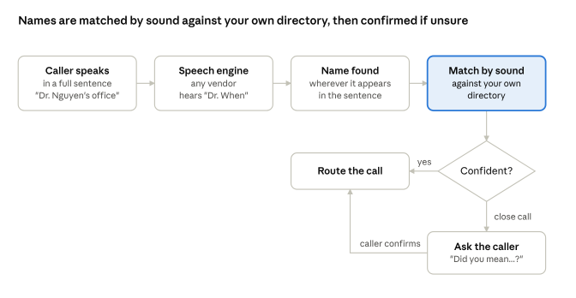
The speech engine can mishear the name; matching by sound against the directory recovers it, and a close call becomes a question rather than a wrong transfer.
What It Changes
Now replay the opening call with name matching in place. The patient says “I need to reach Dr. Nguyen’s office about my results.” The agent replies, “Connecting you to Dr. Nguyen’s office in cardiology,” and she is there. She does not have to repeat herself, spell the name or be transferred to an operator.
For a health system, the difference shows up in four areas:
- Patients reach the right person the first time, in their own words, including callers whose providers have the names general models handle worst.
- Operators and staff get fewer misrouted calls and fewer “I was sent to the wrong office” transfers to clean up.
- Health systems leaving legacy IVRs keep the name accuracy they relied on while gaining a conversational front door.
- IT keeps its options open. Because name recognition does not depend on one speech vendor, the speech engine becomes a choice made on price and performance, not a lock-in.
Test Your Vendor on Names
Most voice AI demos use a scripted caller and a short list of easy names. When you evaluate voice AI, run three tests:
- Bring your own directory. Load your real provider list, all of it, and call in asking for the twenty names your operators say get misheard most.
- Ask in a full sentence. Do not just say “Dr. Nguyen” at a prompt. Ask the way patients talk: “I’m trying to reach Dr. Nguyen’s nurse about a refill.”
- Ask for someone who isn’t there. A good system tells the caller it could not find that name, or asks a clarifying question. A weak system transfers the caller confidently to the wrong person.
Then ask one question: If we change speech engines next year, does name accuracy come with us?
Names are where conversational AI meets the reality of a health system. Reach out to learn more.
Sanjay Yadav is Head of Engineering at Parlance, where he leads the team building the company’s conversational AI platform for healthcare. His work spans real-time voice AI, speech recognition, and integrations with the EHR and contact center systems health systems run on, including Epic, Oracle Health, Meditech, athenahealth, Webex Contact Center and Five9. Since joining Parlance in 2022, he has led the move of the Parlance platform to a microservices architecture and the company’s shift to AI-native product development. Sanjay brings more than 20 years of engineering leadership across healthcare, education, fintech and application security, including founding the engineering team behind a clinical trial SaaS platform at ERT. He speaks regularly on AI architecture and workflow redesign, most recently at Volaris Quadrants and MassTLC.