Meet us at Upcoming Healthcare Events | Details

Main Menu
  • Home
  • Solutions

      Solutions

      Switchboard
      Contact Center
      Clinics
      Speech Attendant
      Call Routing
      Log in
      Request a Demo

      Featured Solution

      Unlocking the Key to Health Equity in the Revenue Cycle

      In Revenue Cycle, people and technology are our greatest assets to eliminate health disparity and achieve health equity.

  • Industries
      Healthcare
      Enterprise
      Higher Education
      Log in
      Request a Demo

      Featured Customer Story

      Hendrick Health Improves Patient Experience

      Duane Donaway, Director of Technology at Hendrick Health, discusses the benefits of Parlance.

  • Resources
      Blog
      Media
      Publications
      Glossary
      Log in
      Request a Demo

      Featured Blog

      Put a Kaizen Lens on the Process of Answering the Phone in a Large Health System

      Learn how to reduce wasted labor and patient frustration as you transform your health system's voice channel.

  • About Us
      About Us
      Our Team
      Customer Stories
      Open Jobs
      Contact Us
      Log in
      Request a Demo

      Featured Team Member

      Linton Featured Team Member - Parlance

      Linton Ranson, IT System Administrator

      At Parlance, we execute monthly employee security training programs and real-world phishing simulation campaigns that reduce our vulnerability to threats and ensure operational integrity. Parlance is fiercely committed to safeguarding sensitive patient information and maintaining regulatory compliance standards.

Log In
Request a Demo
Main Menu
  • Home
  • Solutions

      Solutions

      Switchboard
      Contact Center
      Clinics
      Speech Attendant
      Call Routing
      Log in
      Request a Demo

      Featured Solution

      Unlocking the Key to Health Equity in the Revenue Cycle

      In Revenue Cycle, people and technology are our greatest assets to eliminate health disparity and achieve health equity.

  • Industries
      Healthcare
      Enterprise
      Higher Education
      Log in
      Request a Demo

      Featured Customer Story

      Hendrick Health Improves Patient Experience

      Duane Donaway, Director of Technology at Hendrick Health, discusses the benefits of Parlance.

  • Resources
      Blog
      Media
      Publications
      Glossary
      Log in
      Request a Demo

      Featured Blog

      Put a Kaizen Lens on the Process of Answering the Phone in a Large Health System

      Learn how to reduce wasted labor and patient frustration as you transform your health system's voice channel.

  • About Us
      About Us
      Our Team
      Customer Stories
      Open Jobs
      Contact Us
      Log in
      Request a Demo

      Featured Team Member

      Linton Featured Team Member - Parlance

      Linton Ranson, IT System Administrator

      At Parlance, we execute monthly employee security training programs and real-world phishing simulation campaigns that reduce our vulnerability to threats and ensure operational integrity. Parlance is fiercely committed to safeguarding sensitive patient information and maintaining regulatory compliance standards.

Category Tags

  • agent experience
  • business optimization
  • call routing
  • IVA
  • IVR
  • managed service
  • patient experience
  • security
  • speech attendant
  • switchboard
  • technology
  • Videos
GRAPHIC_Scott D_The Overlooked Oprtunty in Call Cntr Automation AdobeStock_1684488638
Picture of Scott D’Entremont
  • Picture of Scott D’Entremont Scott D’Entremont
22 min

Published on

  • 25 Nov 2025
Share via

Blog Summary

Most health systems invest heavily in digital portals while overlooking the channel patients rely on most: the phone. With 70%+ of patients still calling, and contact centers overwhelmed, healthcare organizations are losing money, staff, and patient loyalty due to outdated systems. Parlance solves this with conversational AI that automates routine tasks, reduces handle time, improves navigation, and frees staff for meaningful work. Case studies like Virtua Health show dramatic results: thousands of agent hours saved, higher self-service rates, better retention, and major gains in patient experience. Modernizing the voice channel isn’t optional; it’s the fastest, highest-ROI opportunity in healthcare operations today.

The Overlooked Opportunity in Healthcare Call Center Automation

I’m in meetings with healthcare CIOs every week. The conversation always starts with financial pressures, a familiar topic these days. Over and over, I say, call center automation is a cost-reduction strategy. It reduces operational expenses, and at the same time it improves patient experience. This is a massive opportunity that most health systems are missing. You simply cannot ignore the phone in healthcare, because your patients, from the youngest to the oldest generations, haven’t. They’re using it, they need it, and they’re judging your entire organization by how well you answer it.


Here’s the reality: Your hospitals and clinics probably mirror the industry norm. Your health system has invested millions in a sophisticated patient portal that serves your digitally engaged patients beautifully. Meanwhile, the majority, 70+% of your patients, encounter outdated phone trees, excessive hold times, and overworked contact center staff struggling to keep up. This isn’t just a patient experience problem; it’s a massive operational inefficiency that’s bleeding money every single day.


The Math That Keeps CFOs Up at Night

By the numbers… Busy healthcare contact centers handle tens of millions of calls annually. When agents spend their time navigating calls, answering repetitive questions about parking and clinic hours, and manually scheduling routine appointments, you’re paying highly trained staff to do work that technology can handle more efficiently. 
 
Virtua Health, a $2.8 billion health system in New Jersey, was facing exactly this problem. Despite major investments in digital transformation, their patient access center was handling over 110,000 calls monthly. Agents were spending significant time just transferring calls. The volume had become a bottleneck.
 
Within the first month of implementing conversational AI automation for their voice channel, Virtua saved 4,395 agent hours, equivalent to eliminating the need for 8 full-time employees. They saw a 17% reduction in calls to patient access despite overall demand growth. Today, their self-service rate has grown from 51% to 68%, and they’ve avoided hiring 100 additional staff despite doubling their call volume.
 
As Malik Bahar, their AVP of Operations, puts it: “Everyone’s biggest expense walks in on two feet.” When you can redirect those feet toward higher-value work instead of hiring more of them, the ROI becomes undeniable.


The Consumer Behavior Reality Check
Here’s what surprised me most in recent research: We’ve all bought into the narrative that younger generations don’t use phones. It’s simply not true, at least not for healthcare.
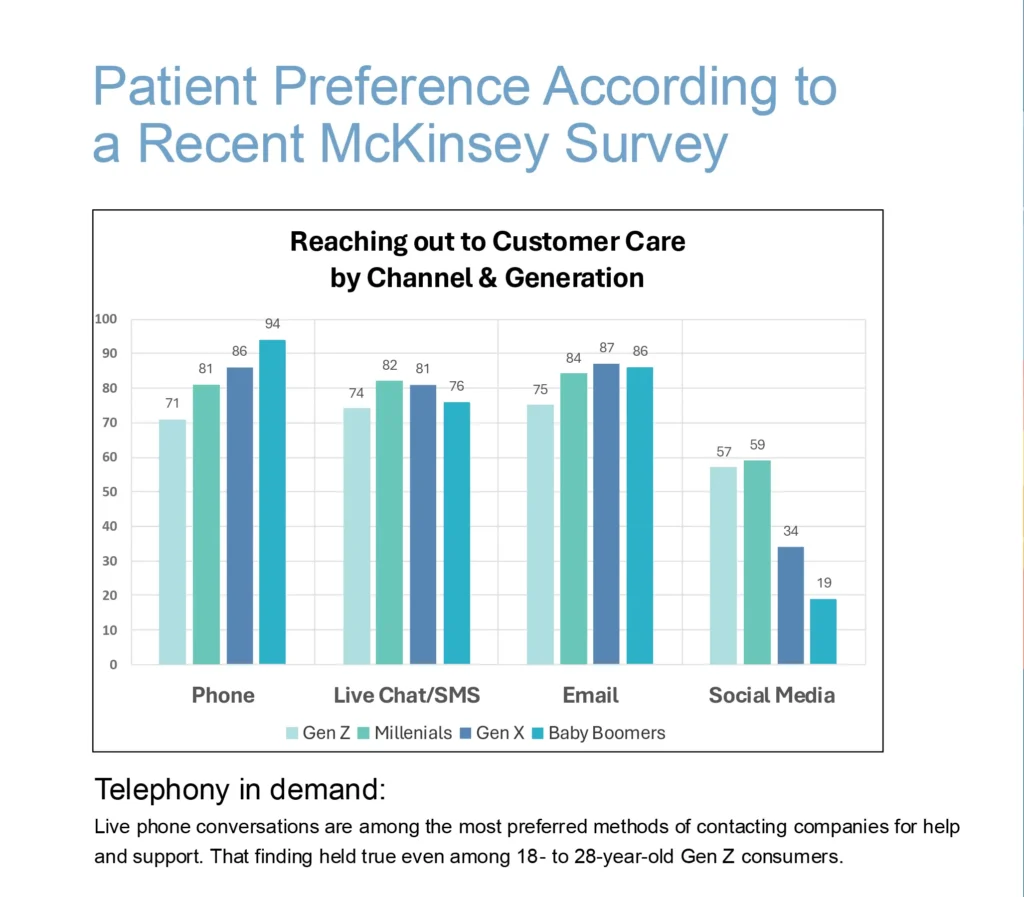
Patient preference - According to McKinsey
 
Recent data shows that 72% of consumers still choose phone calls for fast customer service. Even more striking: 71% of Gen Z, digital natives who supposedly hate phone calls, agree that phone calls are the quickest way to solve complex customer service issues. A financial services company reports that their Gen Z customers are 30-40% more likely to call than millennials.
 
But here’s the critical difference: Gen Z has substantially less patience than older generations. They don’t want to waste time solving a problem online if they know they need to talk to a person. But if you make them wait on hold, they will hang up. You get one, maybe two shots to serve them well before they take their business elsewhere.
 
Think about what that means for your health system. These younger patients have decades of healthcare spending ahead of them. They’re forming opinions about your brand right now based on how well you answer the phone. When they experience frictionless service at Amazon, CVS, and other consumer-focused companies, they’re not going to accept outdated phone systems from healthcare providers.
 
The Technology That Actually Works
Traditional interactive voice response (IVR) systems force callers into rigid menu structures that rarely match how people naturally communicate. Press 1 for this, press 2 for that. Nobody thinks that way, and patients certainly don’t communicate that way.
 
Modern conversational AI fundamentally changes this dynamic. At Parlance, we’ve built technology that enables patients to simply say what they need: “I need to pay my hospital bill” or “What should I wear to my physical therapy appointment?” The system uses natural language processing to understand intent and immediately connects them to the appropriate resource or provides the information they need.
 
This is about creating truly conversational interactions delivered through pleasing, natural-sounding human voices, to save agents from performing repetitive, simple tasks. Voice AI technology integrates seamlessly with EHR systems, enabling HIPAA-compliant patient verification, appointment scheduling, and access to relevant patient information, all while maintaining the security and compliance that healthcare environments demand.
 
The Human Element That Makes It Work
Let me be absolutely clear: This isn’t about replacing humans. It’s about empowering your staff to work at the top of their skillset.
 
When voice AI agents handle routine call routing, answer frequently asked questions, and manage standard appointment scheduling tasks, your trained agents become available for what they do best: providing complex support and empathy for patients who genuinely need human assistance.
 
At Virtua, this transformation led to something remarkable: a 92% employee retention rate in their contact center with a median tenure of 3.9 years, both well above industry averages. When staff can focus on meaningful patient interactions rather than routine transfers and repetitive questions, job satisfaction increases and burnout decreases.
 
That said, let’s be realistic about staffing implications. For many health systems, you will need fewer contact center and switchboard staff when automation handles routine tasks effectively. But instead of viewing this as a threat, consider it an opportunity to avoid future hiring in an environment where healthcare staffing shortages continue to plague the industry. You’re not laying people off, you’re avoiding the need to hire additional staff as call volumes continue to grow.
 
The Financial Case Is Straightforward
I’ve spent much of my career in healthcare IT, and I’ll tell you this: The ROI on voice channel automation is more straightforward than almost any other AI investment your health system can make right now.
 
Consider the typical mid-sized health system handling 1.5 million calls annually. When you reduce average handle time by even 30-60 seconds per call through better routing and self-service options, you’re saving thousands of agent hours monthly. That translates to hundreds of thousands, often millions, in annual savings, real money that can be redeployed toward clinical care.
 
Beyond direct labor costs, there’s revenue leakage to consider. When patients abandon calls due to long hold times or poor navigation, you lose appointment opportunities. When billing questions go unanswered, payments are delayed. When referrals can’t connect easily, they leak to competitors. Depending on what you read, somewhere between 30-50% of referrals escape the healthcare system entirely. Voice automation helps plug those leaks.
 
Virtua saw their Net Promoter Score jump from 20 to 55 following a Parlance implementation, and patients transformed from grudgingly tolerating the phone experience to actively recommending Virtua Health to others. That kind of improvement in brand perception drives patient acquisition and retention, which drives revenue.
 
The Implementation Reality
I know what you’re thinking: This sounds great, but what about our fragmented phone systems? Our multiple call centers? Our inconsistent workflows across different practice groups?
 
You’re right — these are real challenges. As a CIO myself in a previous role, call routing was the bane of my existence. The number of dead ends in our system was staggering. But here’s the thing: You don’t have to solve everything at once.
 
The beauty of modern voice AI is that it can work within your existing infrastructure while you gradually standardize and improve. Start with the most common call types that don’t belong in specific call centers — the navigation problems that create the most waste. A caller asking for a mammogram who’s reached the wrong call center shouldn’t have to wait through an entire queue only to be transferred to another queue.
 
At Parlance, we’ve built proprietary technology specifically designed to excel at proper name and location matching, because we know that in healthcare, getting the call to the right place is foundational to everything else. Our approach is always phased, delivering value incrementally while your workflows evolve.
 
We’re not deploy-and-depart vendors. We operate as a managed service and our customer service professionals have an average tenure of average ten+ years. Among our team members are call center experts, people who’ve run healthcare contact centers, worked in process improvement at health systems, and served as solution architects for major EMR platforms. Our team becomes an extension of your team.
 
The Competitive Imperative
Dennis Pullin, CEO of Virtua Health, emphasizes something crucial: Enhanced consumer experiences translate directly to financial benefits, improved patient acquisition, retention, engagement, and reduced administrative costs. In just four years, Virtua advanced from the 75th to 39th most human-centric healthcare brand nationally, driven in part by their modernized patient access experience.
 
Voice channel modernization isn’t optional anymore; it’s competitive survival. Amazon, CVS, and other consumer-focused companies entering healthcare bring sky-high service expectations. Patients experiencing frictionless customer service in retail and hospitality won’t accept outdated phone systems and frustration from their healthcare providers.
 
Your patients, from the youngest to the oldest generations, are using the phone. They’re judging your entire organization by how well you answer it. When you fail, younger consumers hang up in frustration and walk away convinced your health system has terrible service. They may never come back, and they have many years of healthcare spending ahead of them.
 
The Path Forward
The opportunity in healthcare call center automation isn’t overlooked because it’s complex or unproven. It’s overlooked because healthcare has been so focused on digital portals and online engagement that we forgot where the majority of patient interactions actually happen! It’s on the phone. Voice AI is a necessity.
 
The path forward is clear:
 
  1. Acknowledge the reality: Despite billions invested in digital transformation, voice remains the dominant channel for healthcare communication. Stop fighting this trend and start optimizing it.
  2. Start with navigation: The easiest, most immediate wins come from ensuring calls reach the right destination the first time. This reduces waste and frustration for both patients and staff.
  3. Layer in self-service: Once navigation is solid, add conversational AI capabilities for appointment management, patient verification, and FAQs. These routine interactions don’t require human agents.
  4. Empower your staff: Redirect your human resources toward complex, empathetic interactions where they create real value. Measure satisfaction and retention as key metrics.
  5. Track the ROI: Monitor agent hours saved, call abandonment rates reduced, and patient satisfaction improved. The financial impact becomes visible quickly, often within 30 days.
 
This isn’t about implementing cutting-edge technology for technology’s sake. It’s about applying proven, practical solutions to a massive operational inefficiency that’s costing your health system money every single day while frustrating your patients and burning out your staff.
 
The question isn’t whether to modernize your voice channel. The question is: How much longer can you afford not to?
 

By Scott D’Entremont

Scott D’Entremont is CEO of Parlance Corporation, which provides conversational AI solutions for healthcare systems across the United States. Prior to becoming CEO, Scott served as Chief Revenue Officer and has specialized in healthcare IT for 10 years.

LINKS

  • https://www.mckinsey.com/capabilities/operations/our-insights/where-is-customer-care-in-2024
  • https://www.forbes.com/sites/janicegassam/2019/11/11/dear-businesses-generation-z-does-not-want-to-hear-please-hold/
  • https://www.forbes.com/councils/forbestechcouncil/2025/02/13/hang-up-your-age-old-stereotypes-gen-z-is-on-the-phone-for-customer-service-needs/


TRANSCRIPT:

This episode is brought to you by Parlance. Elevate patient and staff experiences with AI voice driven solutions from Parlance. Automate call handling, streamline switchboards and contact centers, and enable quick, accurate call routing in hospitals and clinics.


Improve patient experience and reduce the workload on your staff. With smart communication solutions from Parlance. Visit ThisWeekHealth. com slash ParlanceCorp today to transform your healthcare interactions.


I’m Bill Russell, creator of this Week Health, where our mission is to transform healthcare, one connection at a time. This is an executive interview


quick powerful Conversations with Leaders Driving Change. So let’s get started.


Today we have an executive interview and I’m excited to be joined by Scott Don Remont, CEO of Parlance corporation. And Scott, welcome back to the show. It’s been a, it’s been a while. It has. Time goes


I was in a CTO meeting last week and we started talking a lot of talk about how to deal with the financial pressures that exists within healthcare. And one of the, one of the people actually brought up parlance and what they’re doing and call center and trying to get in front of things and, Uh, it was specifically in that context of reducing costs. And I thought that was interesting. I’ve heard it in terms of, improving the experience, but it was really both both. And for this CTO.


Yeah. Yeah, that’s interesting. That doesn’t happen often enough that our name comes up in those rooms, so I appreciate that.


I’ll ask you after the interview, maybe I’ll put you on the spot for who that was, but you know, cost. Cost is huge. It represents 30 to 50% of what gets spent in healthcare. Everyone would like to see more spent on. Clinical spending rather than kind of the cost of administering the system. Of course as pressure is increased financially.


That phenomenon has just become more and more important. So we think we have a really straightforward way to help people reduce costs. It’s kind of common sense. It enhances what people Are able to do and lets agents in call centers and at the front desks of clinics and operator groups focus on the places where they really need personal, personalized help and guidance.


And for the routine tasks. Software can go ahead and. Handle those things. I think two other things are becoming more clear as interesting to CTOs and those are just how much leakage there is in referrals and where this kind of technology can help out. I was kind of searching around and depending on what you’re reading, it’s somewhere between 30 and 50% of referrals escape the healthcare system.


And as there’s so much pressure on, reducing, expenses, bringing in more revenue certainly is something that people are more and more interested in as well. And, you can’t forget about patient experience. I think it’s critically important Yeah. To keep our eye on the ball there as we try to manage the businesses.


So help me understand how your solution how does it address leakage and how does it address those referrals going outside?


To automate that process and follow up and call back is one of the ways. The other way is to sort of, share the data across the system and know who might be calling back.


Even things that are as simple as cancellations. We’ll find with our customers that somebody will send a notice out, at four o’clock, close the office. And those calls may well roll to the main hospital system where, an agent will greet the person and say, Hey, thanks for calling.,


How can I help you? And the caller will say, I don’t know, you guys called me. So we’re, we’re able to be able to know who that’s calling and why they’re probably calling back and make that a much better experience.


So Scott, I have a standard colonoscopy coming up and so I have the.


Primary care physician referring, I have the doctor who’s gonna be performing the procedure, and I’m dealing with that office, and I’m dealing with the hospital as well. I can honestly tell you that I think between those three entities this week, I have fielded, I don’t know, eight phone calls, which is great.


Yeah, I mean, they’re very responsive. They’re reaching out, they’re making sure I’m ready. I know where to go, all this other stuff. Right. That’s a lot of phone. I it’s, it’s, it’s like it, they’re over-communicating and it’s almost becoming my wife was like, are like, she heard me talking and she’s like, again, you’re talking to them again.


Yeah. I think it’s hard to get it right. I have the exact same thing going on, except what happened is I got one phone call, I missed it, and then I jotted a time like, oh, Scott, you really have to make this appointment when things calm down in November. But that’s it. I haven’t gotten any other fallback.


It was a live human who’s probably very busy and my name is probably on some list somewhere. And, maybe in another six weeks they’d call me back. But they really don’t have to. Can you imagine if I was able to just hit two and schedule it or pick up the call and get it done right then, and that didn’t need to be a person necessarily.


These are it’s a group I’ve used for a long time. I really wouldn’t need to speak with a person.


Well, it was interesting in the CTO meeting for it to come up in the context of cost savings because that led to a conversation around the call center and it’s like, man, that call center is, first of all, we have a lot of them, we have a lot of, physician practices.


practices.


the CTOs are sort of looking at us going, this is harder than it looks. I’m like, what? Alright, help me understand why it’s so hard. And they’re like, well. Our phone systems aren’t necessarily all linked together yet. We’re a lot better than we were last year, and we’re a ton better than we were three years ago.


But still we have some technical challenges there. Then we’re still dealing with multiple call centers. We’re dealing with integration issues into the EHR itself. I mean, so they were sort of painting a picture of Yes we, we know there’s, it’s like we know there’s gold in, then there hills.


Yeah, but it’s some work to get it.


Yeah. That, That’s part of our experience with our customers too. I’d add on to that, that what we see is even probably a bigger challenge is just standardized workflows. Yep. At the end of the day, if somebody’s sort of tagged as an orthopedist, but they only do left knees on Tuesdays.


Another guy only does hands, they both look like orthopedists. It’s extremely difficult for automation to sort of figure that out. We’ve made great strides forward with AI to be able to be a little smarter about slot selection, but at the end of the day, it’s really about helping guide our customers to those processes, which is why a couple of years ago we went out and hired, not people that are call center experts initially, but people that are expert at kind of consulting with our customers to figure out how do we approach, the practice and how do we kind of, how do we kind of get there? Everything’s always phased for us so that we can kind of deliver value.


The technology’s always ahead of what the system is ready to do, so we try to tee up the next thing. But I would tell you that the number. One easily solved problem in contact centers that we see are calls that don’t belong. So when there’s a lot of call centers, what that means is a lot of call centers get calls they can’t help with, so we’ll find a better, a call center for instance, is doing all kinds of primary care appointments, but they don’t do any of the radiology appointments, but somebody has that phone number, so they’re calling for a mammogram, and they’re waiting through the whole queue only to get to an agent.


That says, geez. We don’t do that here. Hold on, let me transfer to somebody else that may well have a queue. So we’ve continued, it’s kind of in our DNA to be really good at navigating calls around a healthcare system. We think it’s more important than ever. So for our customers, if you call and you ask for a mammogram, you don’t know that you called the wrong number.


We hear mammogram. We send you to the right place in the system for the mammogram. It’s a very practical way to get an immediate savings. It’s the easiest, honestly, part of what we do. It delivers immediate value for our customers there. If you think of Kaizen, Kaizen, sorry, and just waste, there’s nothing more wasteful for the patient or the call center to field calls that you can’t help with at all and need to transfer them as a human operator.


I wanna talk to you about another phenomena. I, I’m, I’m on record just saying two guys in a garage are gonna come out with ambient listening tomorrow because it almost was that kind of thing was going on where people were like, oh my gosh, look what I can do with this large language model.


And I put this in front of it and all of a sudden I have agents and boom. And you have two, two people from a garage coming out there and saying. And we’re in healthcare, it’s like, oh, slow down, slow down there. but it feels like the same thing’s happening in your space. It’s like everybody and their brothers sort of coming outta the blue saying, oh look what we could do with this LLM.


And you’re like whoa. Wait a minute. This is, yeah, for sure. This is healthcare.


Yeah, for sure. I mean, and very bluntly, a lot of those guys go, oh, in a company like parlance that’s been successful for 25 years, that’s a legacy provider. So you wanna do us new shiny stuff even though, we’ve got two customers and 14 salespeople and some money in the bank for the moment that we’re spending down and we’re gonna figure out healthcare ’cause it’s a great application.


According to our VCs, we’re seeing more of that than ever. We’ll be out at Becker’s next week, and there’s some sort of new competitors there. So it’s sort of interesting, we’ve taken a very different approach. The company has been in business for about 28 years.


Last year the company was acquired by Constellation Software. They’re a publicly traded conglomerate that sort of models themselves after Warren Buffet where they acquire a company. The companies remain independent. They’re part of the overall team and have access to those resources, but they continue to operate individually.


These guys have never sold a business, so we feel really lucky to be in that position where we’re not worried about payroll, where we’ve got. Lots of long-term relationships, really smart people both on the healthcare side, people that ran healthcare contact centers, people that were in healthcare it for decades, as well as really sharp developers.


So we think we’re in a really great position, but I’ll tell you, bill, I don’t think it’s been in my seven years in the business any noisier than it is today with sort of new people and more shiny stuff for kind of a confused market to look at.


I mean, I, I want to emphasize the specific industry knowledge is so important in, in a, an application like this, in, in bringing it to fruition.


’cause it’s all about adoption. It’s all about usage. It’s all about creating the experience. It’s all about integration and all of those things require special knowledge within healthcare. But but I don’t want to, I don’t wanna downplay. Some of the really cool things we’re seeing in terms of advances and those kind of things, how are you guys keeping up and what are some of the things some of the newer things that you guys are incorporating?


So, we’re doing kind of two different things. Like everyone, we’re kind of making sure we’re in a position to take advantage of kind of the latest and greatest models that are out there. We’re doing a lot more with small language models now. I think like everyone, Nvidia chips are in there.


That’s probably the one thing that we’re kind of all are looking around and going, holy cow, can this what, what can’t these things do? But at the same time we’re doubling down on. Really using these kinds of technologies to enhance what we’ve been good at for a long time, which is navigation. So we’ve developed some proprietary software that kind of, it’s a vector embedding search model that allows us to match proper names and locations better we think than anyone else.


It’s not something that other people pay a lot of attention to, but we really feel like people skip over the idea of. Nobody can do a great job if you can’t get the call to the right place. That’s kind of where we’re at in the, sort of the, some of those things we’re working on now.


You know, call, call routing was the bane of my existence as a CIO it was amazing how many dead ends we had in that system, but that’s one of the things, once you clean it up and you now have these opportunities, now you can leverage these things like like automation around scheduling and, all that other stuff that’s out there.


Yeah. Yeah. And we’re seeing in the marketing side, as you drive around the country, and I do all the time, and you look at all these billboards for healthcare systems that never have a phone number. They don’t have a phone number because the health system can’t land the call in the right place.


We’ve gotten a couple of customers where somebody threw up an 800 number that went to one small call center that became instantly overwhelmed. Right. And that’s part of what’s we love when that happens truthfully. But it’s. It’s not something you see a lot of because it’s so difficult to route those calls around.


And more and more we’re looking at opportunities where we’re teaming up with marketing to both navigate the calls around the system. Have a better yield on people that are interested in becoming a patient of a new system and then having a better yield on referrals, where we’re a part of kind of the outbound effort to sign up, interested people to come in and join the system.


Yeah, it’s um, it is a fun time to be in the industry. It’s a fun time to be, especially in the space that you guys are in. I think there’s a lot of opportunity. There’s a lot of people looking at it. And Scott, I want to, thank you for for visiting with me and thanks for coming on the show.


Thanks, bill. Always a pleasure. I’ll see you soon.


Together we’re transforming healthcare.

 

Parlance Corporation
400 West Cummings Park, Suite 2000
Woburn, MA 01801

CONNECT WITH US

Linkedin-in

Phone: 888-700-6263

Support: [email protected]

SOLUTIONS

  • Switchboard
  • Contact Center
  • Clinics
  • Speech Attendant
  • Call Routing

INDUSTRIES

  • Healthcare
  • Higher Education
  • Enterprise

RESOURCES

  • Blogs
  • Media
  • Publications
  • Glossary

ABOUT US

  • Why Parlance
  • Meet the Team
  • Careers

CONNECT WITH US

Linkedin-in

Phone: 888-700-6263

Support: [email protected]

Excellence Award 2022
HIPAA Vanta image

© Copyright 2026 Parlance

Privacy Policy
Security Policy