

The Case for Parlance: Transforming Healthcare Communication with AI
The Vital Role of Phone Communication in Healthcare
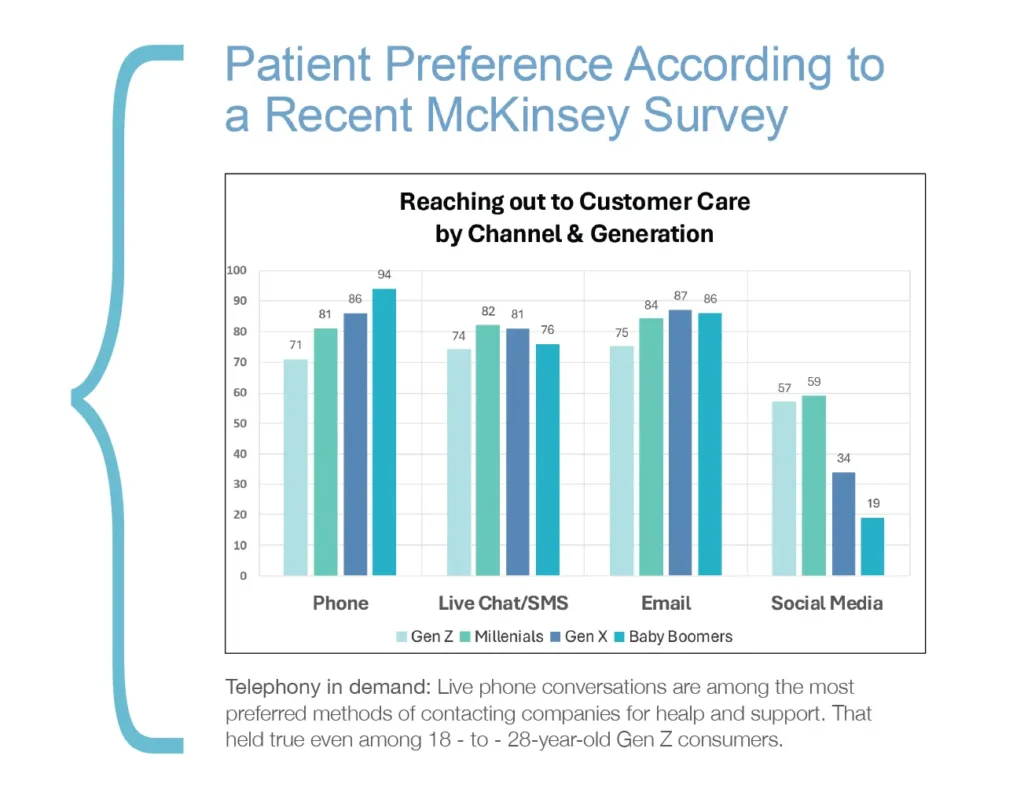
Healthcare CIOs already know this: the phone is still king in healthcare. Despite all the money invested in digital transformation, data shows that 72% of consumers still call when seeking prompt customer service. This preference extends across demographics. From Gen Z to Baby Boomers, no one wants to wait on hold to solve a complicated billing issue or get support for a sensitive health problem. A live phone call is no longer the standard for airline reservations or cable service customer inquiries. Yet in healthcare, where human support is essential, the phone remains indispensable.

The numbers confirm what is happening across healthcare operations:
- Over 70% of individuals (243 million people in the U.S.) rely on phone calls to engage with healthcare providers.
- Fewer than 30% of patients use portals consistently, and over half of patient tasks still require clarification or live support. Portals can’t meet those needs—the phone does.
- 80+% of healthcare appointments are still made over the phone
The Healthcare Communication Challenge
Health systems are dealing with three major problems all at once and voice AI can help:
- Agent Burnout: This is the big one. 44% of non-clinical healthcare staff report work overload. Even more striking, 63% of contact center agents have hit high burnout levels within the past year. This is not sustainable.
- Persistent Labor Shortages: Healthcare contact centers can’t find enough people, and struggle with chronic staffing challenges.
- Misalignment of Digital Investments: Despite continued increases in digital spending, these investments often fail to address the necessary modernization of the voice channel.
The Parlance Solution: Meeting Patients Where They Are
The Parlance intelligent voice assistant (IVA) takes a different approach. Instead of trying to force patients into yet another portal with yet another password, we optimize the voice channel they’re already using. While healthcare portal adoption will continue to grow, the present reality is clear: patients want to speak and be understood. We need to center the experience around patients right now.
When health systems subscribe to Parlance, patients simply use their voices to interact naturally and don’t need to remember a password to be verified. By letting healthcare consumers continue to use the phone, Parlance eliminates friction, enhances access, and reduces the administrative burden on contact center agents. This makes for a more intuitive patient journey and a measurable lift in both patient and agent satisfaction.
Quantifiable Results
The outcomes are real and measurable:
- Parlance engages over 80+% of callers effectively.
- UW Medicine: Parlance IVR handled almost 4 million calls in the last year – 3,941,303 to be exact. The average self-serve rate was 84.3% and the average offload was 87.9%!
- UW Medicine: Parlance IVA handled 749,700 calls in the last year, with an average self-serve rate of 87.2% and an average offload of 91.1%!
- HCA Enterprise: Parlance IVR handled over 11 million calls in the last year – 11,131,519 to be exact. The average offload rate across all divisions and applications was 65%
- Virtua Health: Press Ganey patient satisfaction improvement metrics showed a 13%. increase in Ease of Contact and a 29% increase in Ease of Scheduling within 9 months. Self-service grew from 51.5% to 68.2% of all calls. Virtua’s net promoter score climbed from 20 to 55 after Parlance was implemented at the health system’s digital front door.
- One midsized health system with 11 hospitals and 1.5 million annual calls realized these outcomes: $1,456,800 in annual cost reduction, 6,070 monthly agent hours saved in their first live month, and 18 weeks of equivalent human labor recovered in the initial 30-day period.
- One major healthcare system saved the equivalent of 45 weeks of labor in a single month, after implementing Parlance.
Key Advantages
- Optimized Operations
Parlance automates the routine tasks; call routing, answering FAQs (frequently asked questions), voice-based appointment scheduling. Parlance integrates with existing EHR systems and workflows. And hold times? They drop dramatically. - Enhanced Agent Experience
When you offload the repetitive calls, agents can actually do meaningful work. Less burnout. Greater satisfaction. They get to work at the top of their skill set instead of answering the same questions, 50 times a day. - Improved Patient Access
Patients get connected to the right resource quickly. Do you want be # 26 in a call queue? When people need a human for something complex or emotionally sensitive, a human can be available, when conversational AI takes routine work away from those agents. Patients who aren’t tech-savvy (and there are millions of them), still need to access care. Hospitals and clinics need to meet people where they are. - Proactive Patient Engagement
Here’s where it gets really interesting. When your agents aren’t drowning in inbound calls, they can actually do outbound work. Population health management. Proactive outreach. You shift from always playing defense to being on offense. Instead of a line out the door and queue lights blinking constantly, your team has bandwidth for the strategic activities that move the needle.
The Parlance Difference
We’ve been doing this for over 25 years. That matters more than you might think. In healthcare IT, we’ve watched companies come and go. Remember Olive? That instability is a real risk when you’re making a long-term technology investment. You don’t want to build your entire workflow around a vendor that may disappear in a few years. Venture capital investment may help startups to gain traction, but it’s the results that come from true expertise and long-standing client relationships that keep a company thriving over decades.
Early on, we learned something important: AI doesn’t run itself. The best implementations happen through ongoing collaboration, not a one-time setup. That’s why Parlance is a managed service. Your day-to-day interactions with our team are included, not add-ons you have to negotiate for.
Our team has deep healthcare expertise. We’re not a general-purpose AI company that decided healthcare looked profitable. We’ve been focused on healthcare communication for decades, and that experience shows in how our solution works.
What makes us different:
Managed Service Partnership: Your team won’t need to become AI or telephony experts. We handle the technical complexity. We monitor your system proactively. We bring you what’s new and what’s next before you have to ask for it. It takes minimal effort on your end to keep everything optimized.
Proven Performance: We deliver guaranteed results with fast ROI. This isn’t experimental, it’s been proven across thousands of implementations.
Natural Voice Interaction: Patients talk normally. They get where they need to go quickly. They get answers to questions or manage appointments without having to log onto a portal or face any friction.
Pragmatic AI Implementation: It’s safe, affordable, and actually works. No hype, just practical technology that solves real problems.
Conclusion
If you’re a CIO or patient access executive thinking about digital transformation, the voice channel deserves serious attention. Yes, we all want patients using portals. But right now, today, they’re calling. And they’re going to keep calling because healthcare is complicated and the stakes are high.
Parlance addresses the reality of how patients actually behave, not how we wish they’d behave. We accommodate different preferences, different needs, and different levels of accessibility across your entire patient population.
When you implement voice-driven, HIPAA-compliant IVRs and IVAs, you get multiple wins at once: better patient experience, more efficient operations, reduced staff burnout, and that critical shift from reactive firefighting to proactive engagement. That’s not just an incremental improvement, it’s a fundamental change in how patient access works.
By Katie Cardarelli